Los Algodones, Baja California

Explore

Stories from a four-block border town.

The full archive of history, care, travel, and the people behind Molar City.

The archive

19 stories and guides from cotton fields to Molar City.

The town’s name means “the cotton plants.” The rest is a story of river crossings, border booms, one dentist who changed everything—and the practical advice that helps you navigate it today.

Showing 19 of the archive’s stories and guides.

Wooden signpost with Vicente Guerrero, Los Algodones, and Molar City signs framed by cotton bolls1894–Now History5 min Three Names, One City: How Vicente Guerrero, Los Algodones, and “Molar City” Tell the Same Story Vicente Guerrero, Los Algodones, and “Molar City” trace the same 130-year journey from a cotton outpost to the dental capital of the world. Read the chapter Cotton bolls growing along the Colorado RiverPre-1894 History1 min The Cotton Fields Long before dentists and pharmacies, wild cotton grew along the banks of the Colorado River, giving this border town its name. Read the chapter A wooden canoe with paddles resting among reeds at a misty river edgeBefore 1848 History4 min The Original Peoples of the River Bend: Quechan, Cocopah, and Kumeyaay Long before the border, cotton farms, or dental clinics, the Quechan, Cocopah, and Kumeyaay peoples shaped the Colorado River bend where Los Algodones now stands. Read the chapter A sepia view of a 19th-century desert town street1894 History1 min Founding: 1894 Officially established on July 27, 1894, the town was placed at the northernmost point of Mexico where the Colorado River enters the country. Read the chapter The historic Andrade border crossing1909 History1 min The Border Crossing The Andrade Port of Entry was established in 1909 when the Southern Pacific Railroad built a branch across the international line. Read the chapter A candlelit cantina during the Prohibition era1920s History1 min The Prohibition Boom In the 1920s, Americans crossed the border to escape Prohibition. Cantinas, gambling halls, and burrito stands created the first tourism economy. Read the chapter Portrait of Dr. Bernardo Magaña seated beneath framed certificates1969 History1 min The First Dentist In 1969, Dr. Bernardo Magaña arrived fresh from dental school. The town had bars and zero dentists. Over 50 years, he built 300 clinics. Read the chapter A modern dental clinic in Los Algodones1980s–Now Molar City1 min Molar City With 350+ dental offices in four blocks and 1,000+ dentists, Los Algodones has the highest concentration of dentists per square mile on Earth. Read the chapter Medications, eyeglasses, and dental crowns arranged on a tableToday Molar City1 min Pills, Porcelain & Pavement Regulars say you come to Algodones for three things: affordable medications, dental crowns, and colorful walkable streets. Read the chapter A dental technician milling a crown in a modern Los Algodones dental lab2026 Molar City1 min A Modern Marvel From 3D-printed crowns to stem cell therapy, the clinics of 2026 have embraced digital-first care and medical innovation. Read the chapter A gloved hand holds a finished tooth crown above a tablet showing a digital dental model2026 Molar City5 min How Advanced Are Dental Labs in Los Algodones? Separating digital reality from AI hype. Read the chapter The corner Liqui’s Pharmacy–Liquors building painted purple in Los Algodones2000s–Now History6 min The Rise, Reign, and Reinvention of Los Algodones’ Famous “Purple Stores” What happened to Liqui’s, the pharmacy that greeted generations at the border? Read the chapter Illustrated map of the Colorado River border region with a cotton field, cantina, and dental clinic1894–Now History5 min How a Map Fluke Turned a Cotton Outpost into a 48-Bar Prohibition Town—and Then “Molar City” How a border-survey quirk, Prohibition, and one dentist transformed a small cotton town. Read the chapter Illustrative scene of a visitor carrying dental records past a street promoter outside a clinic in Los Algodones2026 Essentials10 min How Trustworthy Is Los Algodones? A 7.0 / 10 Guide to Dental Care, Pharmacies, and Safety Daytime safety and vetted clinics score high. The risk is improvisation—so here is how to verify care, avoid scams, and protect your money. Read the chapter Illustrative scene of winter visitors walking between dental clinics in Los Algodones at sunset2020–Now Essentials5 min Los Algodones by the Numbers: 6,796 Residents, 2,000 Homes, and 300+ Clinics The census count is precise; the daytime crowd is not. Here is what official records show—and why the town feels larger than its 2.38 square kilometers. Read the chapter Illustrative courtyard hotel with a small pool, warm lanterns, and gated parking in Los Algodones at dusk2026 Essentials6 min Staying Overnight in Los Algodones: How Many Hotel Rooms Exist—and Is It Actually Safe? The town has only about 120 to 160 hotel rooms, so winter stays need planning. Here is the hotel landscape, the safety picture, and what guests report after dark. Read the chapter A map, passport, sunglasses, and British, German, and Australian flags on an airplane tray table above the clouds2026 Travel5 min Beyond North America: Why Europeans, Brits, Australians, and Expats Travel to Los Algodones for Dental Work Long-haul patients usually come for one reason: complex dental work that costs far less than care at home. Here is how savings, expat life, lab speed, and global implant brands make the trip worthwhile. Read the chapter Two people shaking hands across a painted street line, one wearing a U.S.-flag wristband and the other a Mexican-flag wristband2026 Economy5 min Two Towns, One Economy: How Yuma and Los Algodones Power Each Other Across the Border Separated by ten miles of desert, Yuma and Los Algodones run on the same cross-border engine. Here is how winter visitors, airports, tribal land, and everyday spending keep both economies moving. Read the chapter Illustrative image of a line of people waiting outside a warmly lit venue at night2026 Nightlife6 min After the Dentist Closes: What Nightlife, Spas, and Adult Entertainment Really Look Like in Los Algodones Los Algodones built its reputation on daytime dental care, not late-night clubs. Here is what really happens after the drills stop, from cantinas and spas to the town’s deliberately quiet adult scene. Read the chapter

Filter by topic, or open any story.

The people

Three lives that shaped the town.

A landowner, a dentist, and a greeter: three very different people who left their mark on the same few blocks.

Portrait of General Guillermo Andrade in a bowler hat

The landowner

General Guillermo Andrade

In the late 1800s, the land beneath Los Algodones belonged to General Guillermo Andrade. His ranch brought farmhands from across Mexico — the “Andrade Cowboys” — and laid the agricultural foundation for the town.
Dr. Bernardo Magaña seated beneath framed certificates

The first dentist

Dr. Bernardo Magaña

Magaña arrived from Mexico City in 1969, when the town had dozens of bars and no dentists. Over five decades he helped turn a sleepy crossing into a network of more than 300 clinics.

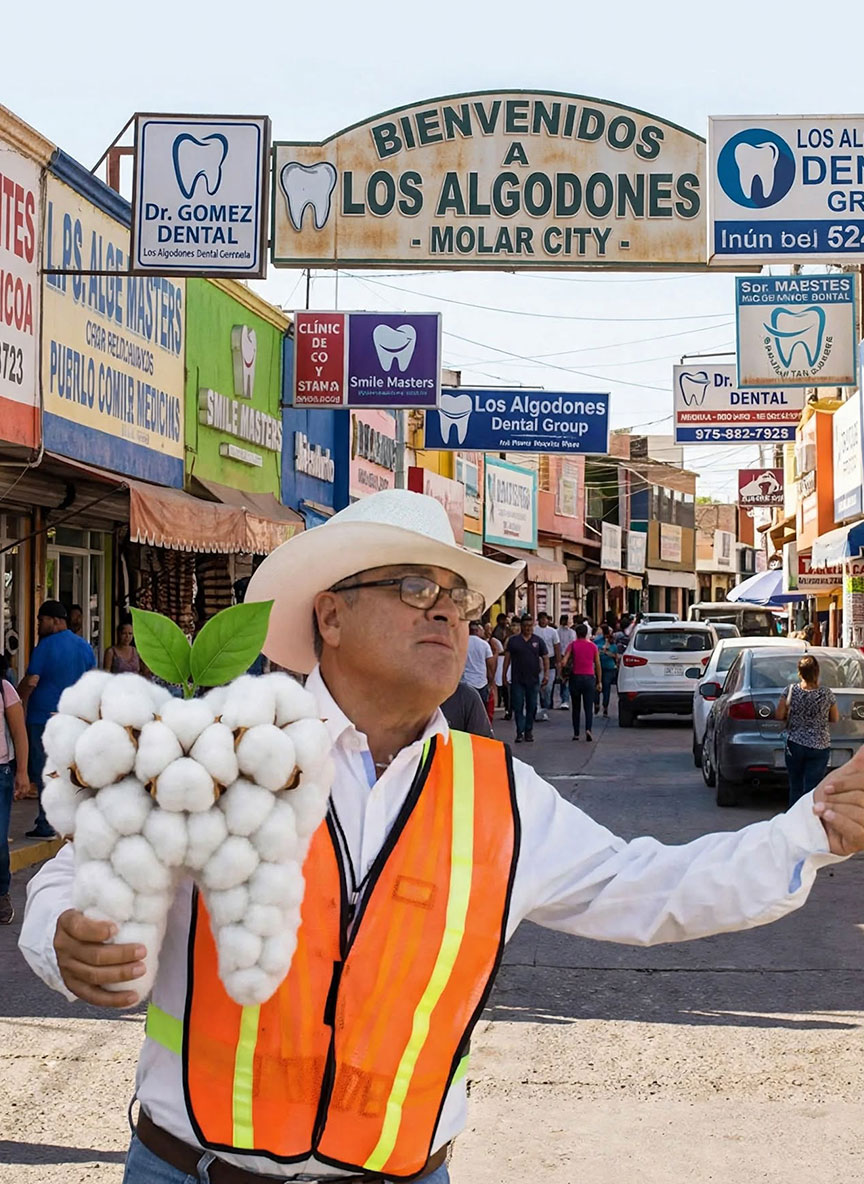
Memo holding a cotton branch beneath the Los Algodones welcome arch

The welcome

Guillermo “Memo” Pérez

For nearly 20 years, Memo stood at the border in the heat, holding a handmade tooth sign that read “Welcome to Molar City.” For thousands of nervous patients, he was the first friendly face in Mexico.

Timeline

A 132-year timeline.

From Indigenous cotton fields to 3D-printed crowns.

  1. Pre-1800

    The Halchidhoma and Quechan peoples cultivate wild cotton along the Colorado River, establishing the agricultural roots that would give the town its name.

  2. 1848

    The Treaty of Guadalupe Hidalgo draws the U.S.-Mexico border through the region, dividing Cocopah lands and establishing the boundary that defines the town.

  3. 1894

    Los Algodones is officially founded on July 27, named for the cotton plants that grew wild along the river. A Symposium in 1995 confirmed this date after three days of research.

  4. 1909

    The Andrade Port of Entry is established when the Southern Pacific Railroad builds a branch across the international line, creating the gateway to Mexico's northernmost town.

  5. 1920s

    Prohibition-era Americans flood across the border for alcohol, gambling, and the famous burrito stands. The town's first real tourism boom transforms it into a "red zone" of cantinas and bars.

  6. 1937

    The "Asalto a las Tierras" — led by Hipólito Rentería and Leonardo Guillén, hundreds of Mexican farmers march onto foreign-held ranches to reclaim the land. The Colorado River Land Company's monopoly is dissolved and the land redistributed into the ejido system, placing ownership directly into local Mexican families' hands.

  7. 1942–1964

    The Bracero Program makes Los Algodones a critical international transit hub. Thousands of Mexican laborers legally enter the U.S. through the Andrade crossing and train depot to work agricultural fields across the Southwest, cementing the town's identity as a cross-border gateway.

  8. 1950s

    The Mexicali Valley booms into Mexico's single largest cotton-producing zone. Los Algodones thrives on agriculture — the "Golden Age of White Gold" — long before healthcare enters the picture.

  9. 1969

    Dr. Bernardo Magaña arrives as the town's first dental surgeon. He sees 9 patients on his first day and would eventually see up to 100 per day at his peak.

  10. 1980s

    Medical tourism reputation overtakes agriculture. An "explosion" of pharmacies opens as U.S. healthcare costs soar. The town's identity shifts from farming to healthcare.

  11. 2007

    MolarCity.com launches — the digital platform that helps American and Canadian snowbirds safely navigate the sea of clinics. This popularizes the nickname "Molar City" internationally and digitizes the town's dental industry.

  12. 2026

    Los Algodones serves 3,000–4,000 visitors daily during peak season. With 3D-printed crowns, stem cell therapy, and telehealth follow-ups, it has become a beacon of medical innovation. Dr. Bernardo Magaña — the man who started it all — passed away on March 31, 2026. His legacy lives on in the thousands of dentists who practice here and the millions of patients who received affordable care.