Drive ten miles west of Yuma, Arizona, and step across a narrow desert border crossing into northern Baja California, and you will enter a compact community known around the world by three completely different names.
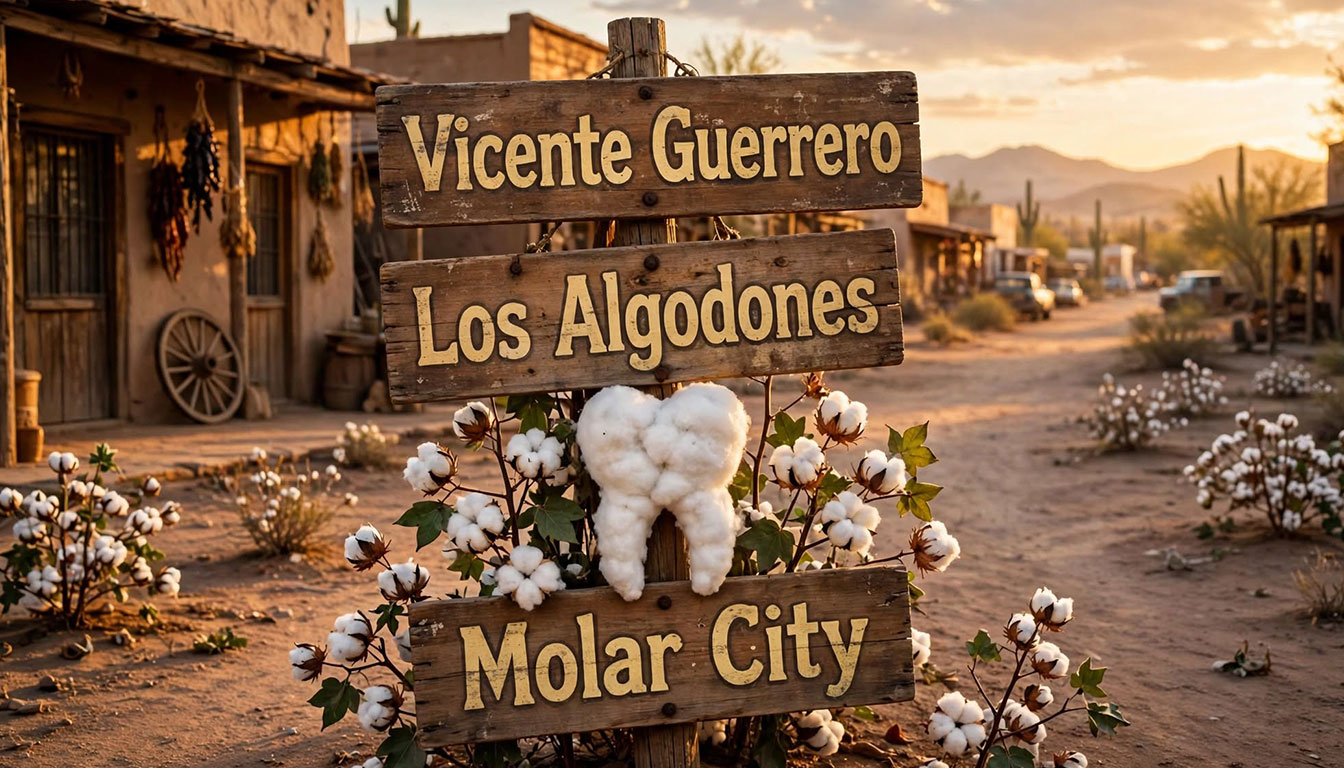
Mexican maps and municipal records give the town a formal name: Vicente Guerrero, honoring the independence leader and second president of Mexico. Residents and Mexican travelers call it Los Algodones. And to hundreds of thousands of American and Canadian visitors every winter, it is simply “Molar City.”
Together, those three names trace the entire 130-year journey of how an isolated Colorado River cotton outpost transformed into the dental tourism capital of the world.
1. Vicente Guerrero: The Name on the Map
The formal name honors Vicente Ramón Guerrero Saldaña (1782–1831), one of the leading commanders of Mexico’s War of Independence and the country’s second president.
Born in Tixtla, in present-day Guerrero, he rose from a rural background to become a general in the independence struggle. As president in 1829, he issued a decree abolishing slavery—a measure that made him a lasting symbol of Mexican liberty.
The name is a formal tribute rather than the name residents use. On the street and in everyday conversation, the town is Los Algodones; Vicente Guerrero survives on government maps, census records, and official documents. That gap between the map and the street is the first of the town’s three identities.
2. Los Algodones: “The Cottons” and the Border Boom
When settlers named the town itself, they looked at the landscape around them. Wild cotton plants grew naturally along the fertile riverbanks, inspiring the name Los Algodones—Spanish for “The Cottons.” The name stuck because it described what residents saw every day, while Vicente Guerrero remained the name on official paper.
For its first seventy years, Los Algodones lived up to both its farming roots and its border geography:
- The Cotton Era: Irrigated delta fields turned the surrounding valley into a major agricultural producer through the early-to-mid 20th century.
- The Prohibition Boom: Because a curve in the border placed Los Algodones within walking distance of both Arizona and California, U.S. Prohibition in the 1920s turned the quiet farming village into “The Official Cantina of the Valley,” eventually packing 48 bars and saloons into a few dusty blocks.
By the 1960s, however, upstream dams and heavy water diversions dried up the local cotton economy, leaving Los Algodones at an economic crossroads.
3. “Molar City”: How One Dentist Rebranded a Town
The town’s third—and most famous—identity began in 1969, when a young dentist named Dr. Bernardo Magaña opened a small practice across from the border crossing. Word spread quickly among American retirees wintering in sunny Yuma that they could walk across the border and receive high-quality dental work for a fraction of U.S. prices.
After being elected mayor in the early 1980s, Dr. Magaña helped shut down rowdy Prohibition-era saloons and invited dozens of young dentists to open offices. Over the next four decades, pharmacies, optical shops, and dental clinics replaced nearly every bar in town.
Today, with more than 300 dental clinics and hundreds of dentists packed into four walkable blocks—serving a permanent town of fewer than 7,000 residents—travelers and international media gave the community its modern nickname: “Molar City.”
One City, Three Chapters
Every visitor who walks across the border today steps through all three identities at once: Vicente Guerrero on the map, Los Algodones in the streets, and Molar City in the dental chairs. Few communities in North America have reinvented themselves so completely—or worn so many names along the way.